Jacobean Embroidery Patterns: 15 Free Printable Crewel Designs with Stitch Maps
Jacobean embroidery is the style of curling leaves, fantasy flowers and fruit filled with tiny lattices, the kind of design that looks like it grew on its own across the fabric. It looks complicated, but every motif is built from a short list of stitches: long and short shading, laid work with trellis couching, stem stitch, satin stitch and a handful of knots.
Below are 15 Jacobean embroidery patterns, each shown as a stitch map: the finished motif with every stitch labeled, the DMC colors and step-by-step notes. Start with a single leaf or the strawberry, then work up to the fox and the pomegranate.
In This Post
- What Is Jacobean Embroidery?
- What You Will Need
- The Stitches Behind Jacobean Designs
- Free Printable Jacobean Patterns (PDF)
- 15 Jacobean Embroidery Patterns
- 1. Jacobean Lattice Flower
- 2. Jacobean Trellis Leaf
- 3. Jacobean Strawberry
- 4. Jacobean Tulip
- 5. Jacobean Acorn
- 6. Jacobean Berry Branch
- 7. Jacobean Spiral Tendrils
- 8. Jacobean Paisley
- 9. Jacobean Lattice Heart
- 10. Jacobean Butterfly
- 11. Jacobean Thistle
- 12. Jacobean Acanthus Leaf
- 13. Jacobean Tree of Life
- 14. Jacobean Pomegranate
- 15. Jacobean Fox
- Jacobean Embroidery on Clothes
- Jacobean Embroidery FAQ
What Is Jacobean Embroidery?
Jacobean embroidery is a style of crewel work named after the reign of James I of England. Its designs are full of stylized, imaginary plants: oversized flowers, curling acanthus leaves, pomegranates, thistles, small animals and birds, often growing from a twisting tree or a little mound of earth.
Traditionally it is worked in fine wool on linen twill, which is why you will also see it called Jacobean crewel embroidery. Today many stitchers work the same designs in six-strand cotton floss on plain linen, and that is how every pattern below is stitched.
What makes a design Jacobean is less the motif and more the way it is filled. Shapes are shaded with long and short stitch, outlined with stem or chain stitch, and filled with patterned fillings: lattices, seed stitches, knots and scalloped edges.
What You Will Need
- Linen or linen-cotton fabric — natural cream or oatmeal, medium weight, prewashed and ironed.
- DMC six-strand embroidery floss — the colors for each pattern are listed with its stitch map.
- Crewel wool (optional) — for a traditional raised, matte look.
- Embroidery needles size 7–9 for floss, and a size 22 chenille needle if you stitch with wool.
- An embroidery hoop or a stretcher frame — 6 to 8 in (15–20 cm). Laid work stays even only on drum-tight fabric.
- A water-soluble fabric pen or a fine pencil for transferring the design.
- Felt scraps for padding raised berries and seeds.
- Small sharp embroidery scissors.
The Stitches Behind Jacobean Designs
Every stitch map below uses the stitches from this list. If one is new to you, practice it on a scrap first.
- Long and short stitch — rows of staggered straight stitches that blend one shade into the next. The main shading stitch for petals, leaves and fur.
- Laid work with trellis couching — long parallel threads laid across a shape, then a diagonal grid of threads tied down at each crossing with a tiny stitch.
- Satin stitch — smooth straight stitches laid side by side across a shape. Padded satin stitch is worked over felt or a layer of stitches for a raised look.
- Stem stitch — a twisted rope line for stems, veins and outlines. Rows of it can also fill a shape.
- Split stitch — a fine line where each stitch comes up through the one before it. Good for outlines under shading.
- Chain stitch — a line of linked loops for bold outlines.
- Fishbone stitch — slanted stitches crossing at a center line, perfect for leaves.
- Buttonhole stitch — looped stitches along an edge that form a scalloped or ridged border.
- Coral stitch — a line with a small knot at every step.
- Fly stitch, lazy daisy, seed stitch — small detached stitches for sprigs, buds and scattered fillings.
- French knots and bullion knots — round dots and longer raised coils.
Need a refresher on the basics? Our stitch guide covers the most common ones step by step:
Hand Embroidery Stitches: 20 Basic Stitches for Beginners
From Maker Warmth
Looking for your next stitch project?
Every pattern on this blog is free to print, from tiny bows to full denim jacket designs. Save this one, then browse the whole collection.
See all free patterns →Free Printable Jacobean Patterns (PDF)
All 15 outlines are in one free PDF, one design per page, numbered the same way as the stitch maps below. Print at 100% (actual size) and trace onto your fabric with a water-soluble pen or a light box. The outlines are simplified for tracing: use them for the shapes, and follow the stitch maps for the fillings and colors.
15 Jacobean Embroidery Patterns
The patterns go roughly from easiest to most detailed. Use 2 strands of floss for shading and fine lines and 3 strands for outlines and knots unless a step says otherwise.
1. Jacobean Lattice Flower

The classic Jacobean flower: plump shaded petals around a lattice center, with a crown of gold knots on top.
Stitches: long and short stitch, laid work with trellis couching, satin stitch, stem stitch, French knots.
DMC colors: 3350, 3733, 469, 729.
Printable outline: page 2 of the free PDF.
- Shade each petal with long and short stitch, starting with 3350 at the outer edge and blending into 3733 toward the center.
- Fill the center with laid threads in 3350, add a diagonal grid on top and tie each crossing down with a tiny stitch; outline the center in 729.
- Work the straight leaf in satin stitch with 469, the double stalk in stem stitch, and fill the curled leaf with close rows of stem stitch.
- Finish with a row of French knots in 729 above the top petal.
2. Jacobean Trellis Leaf
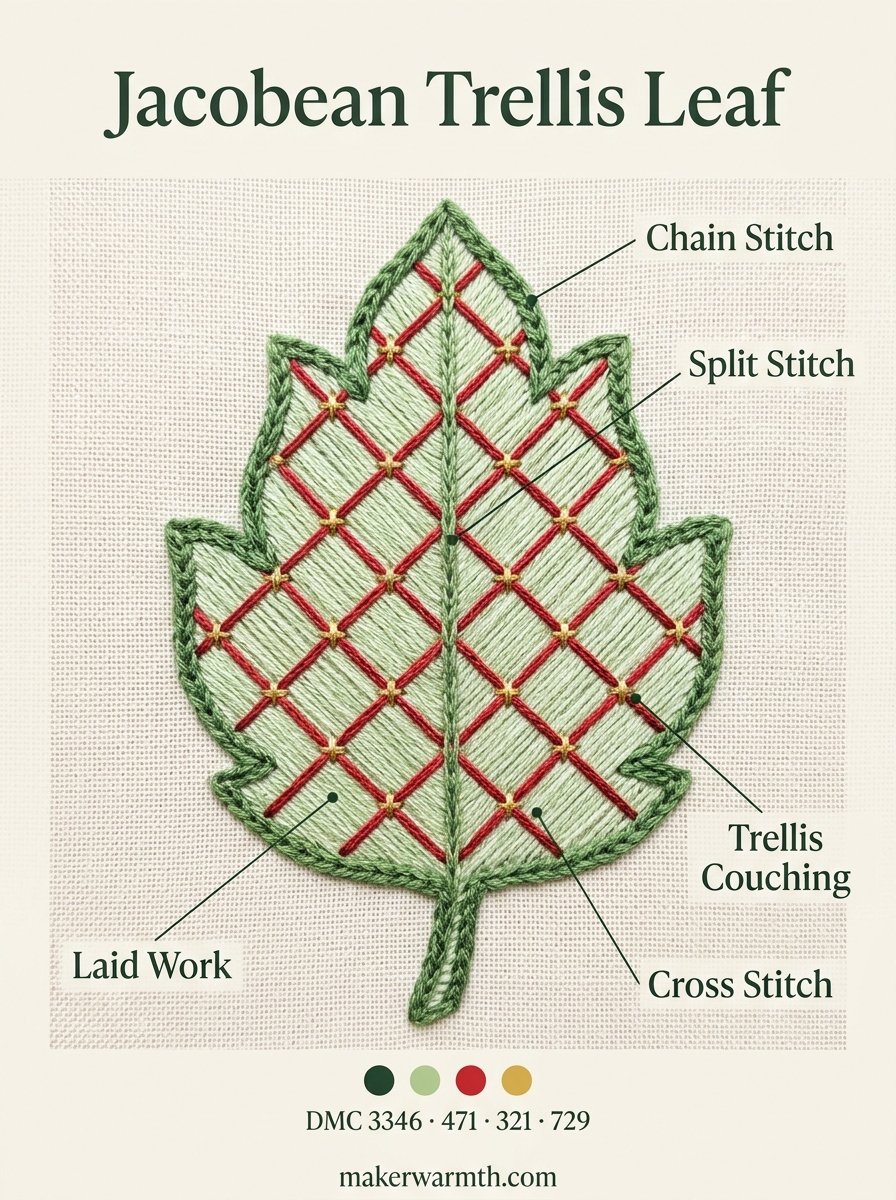
One leaf, one filling. This is the best way to learn trellis couching before you use it in bigger designs.
Stitches: laid work, trellis couching, cross stitch, chain stitch, split stitch.
DMC colors: 3346, 471, 321, 729.
Printable outline: page 3 of the free PDF.
- Fill the leaf with parallel laid threads in 471, edge to edge, keeping them flat and touching.
- Lay long diagonal threads in 321 in both directions to form a diamond grid.
- Tie down every crossing with a small cross stitch in 729.
- Outline the leaf in chain stitch with 3346 and add the central vein in split stitch.
3. Jacobean Strawberry

A quick motif with only four stitches. Strawberries are a traditional part of Jacobean and Elizabethan designs.
Stitches: satin stitch, seed stitch, lazy daisy, stem stitch.
DMC colors: 321, 498, 726, 469.
Printable outline: page 4 of the free PDF.
- Fill the berry in satin stitch with 321, using 498 along one side for shading.
- Scatter small seed stitches in 726 over the berry.
- Make the calyx with lazy daisy stitches in 469.
- Stitch the curved stem in stem stitch and add the small flower at the end.
4. Jacobean Tulip
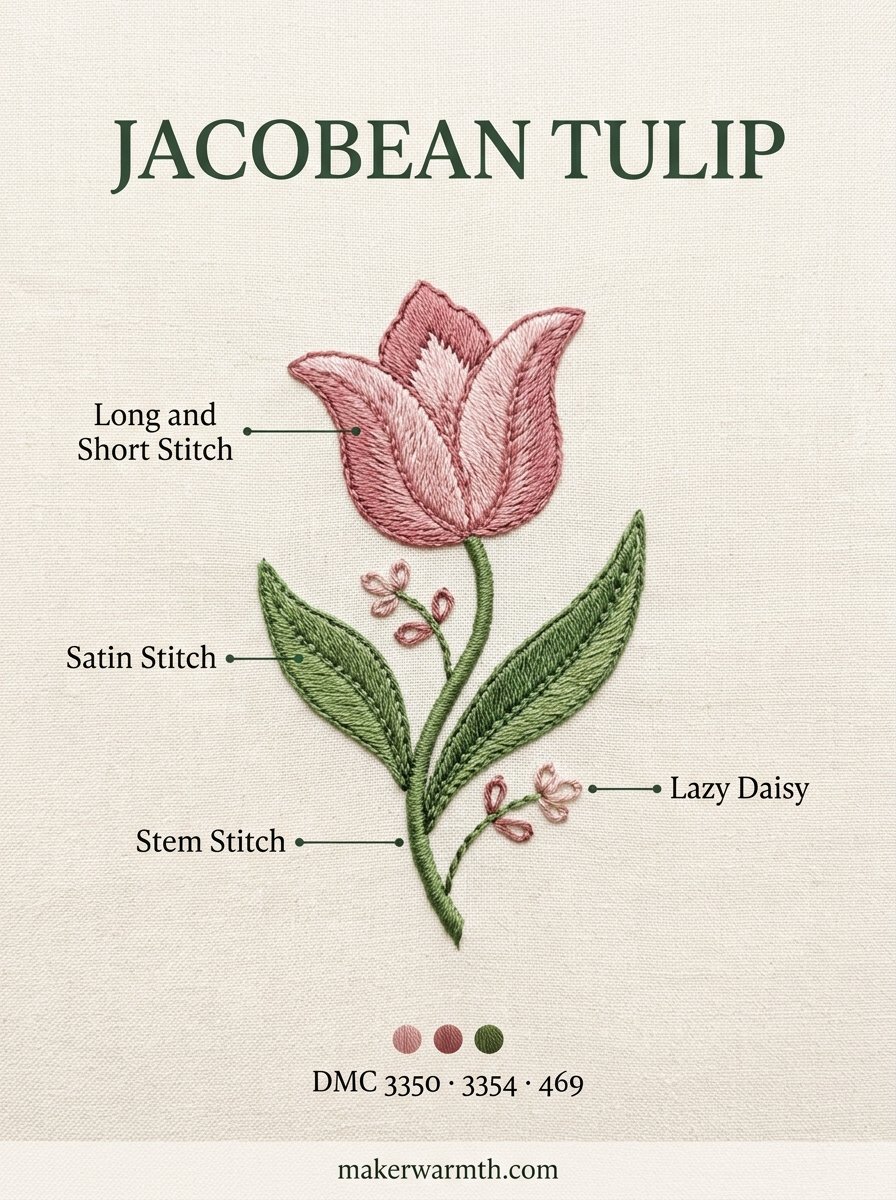
Three soft petals, two leaves and a few buds. A good second project after the trellis leaf.
Stitches: long and short stitch, satin stitch, stem stitch, lazy daisy.
DMC colors: 3350, 3354, 469.
Printable outline: page 5 of the free PDF.
- Shade the petals with long and short stitch, 3350 at the base fading into 3354 at the tips.
- Fill the leaves in satin stitch with 469, angling the stitches toward the center line.
- Stitch the stem in stem stitch.
- Add small lazy daisy buds in 3354 along the stem.
5. Jacobean Acorn

A glossy satin acorn with a lattice cap and a curling oak leaf.
Stitches: satin stitch, laid work with trellis couching, fishbone stitch, stem stitch.
DMC colors: 976, 3045, 3346, 937.
Printable outline: page 6 of the free PDF.
- Fill the nut in satin stitch with 976, adding 3045 on the lit side.
- Cover the cap with laid threads and a couched lattice in 3045 and 976.
- Work the oak leaf lobes in fishbone stitch with 3346.
- Add the stem and the curling tendril in stem stitch with 937.
6. Jacobean Berry Branch

Raised berries clustered along a dark branch. Padding makes them round and catches the light.
Stitches: padded satin stitch, French knots, stem stitch, lazy daisy, seed stitch.
DMC colors: 498, 321, 3345, 938.
Printable outline: page 7 of the free PDF.
- Stitch the branch in stem stitch with 938.
- Pad each berry with a small felt circle or a few satin stitches, then cover it in satin stitch with 321 and 498.
- Add a French knot at the tip of each berry.
- Make the leaves with lazy daisy stitches in 3345 and scatter seed stitches around the clusters.
7. Jacobean Spiral Tendrils

Curling lines and two little roses. Use it alone or as a filler between larger motifs.
Stitches: whipped backstitch, coral stitch, woven wheel rose, French knots.
DMC colors: 3768, 924, 3733, 832.
Printable outline: page 8 of the free PDF.
- Backstitch the spirals in 3768, then whip each line with a second thread for a smooth cord.
- Work the knotted line beside them in coral stitch with 924.
- Make two woven wheel roses in 3733: five spokes, then weave over and under until the spokes are covered.
- Add French knots in 832 at the tips of the spirals.
8. Jacobean Paisley

A blue teardrop with a scalloped inner edge and a scatter of seed stitches inside.
Stitches: chain stitch, buttonhole stitch, seed stitch, fly stitch.
DMC colors: 930, 932, 3810, 832.
Printable outline: page 9 of the free PDF.
- Outline the teardrop in chain stitch with 930.
- Work a scalloped buttonhole edge inside it with 3810.
- Fill the center with small seed stitches in 932.
- Add fly stitch sprigs in 832 around the outside.
9. Jacobean Lattice Heart
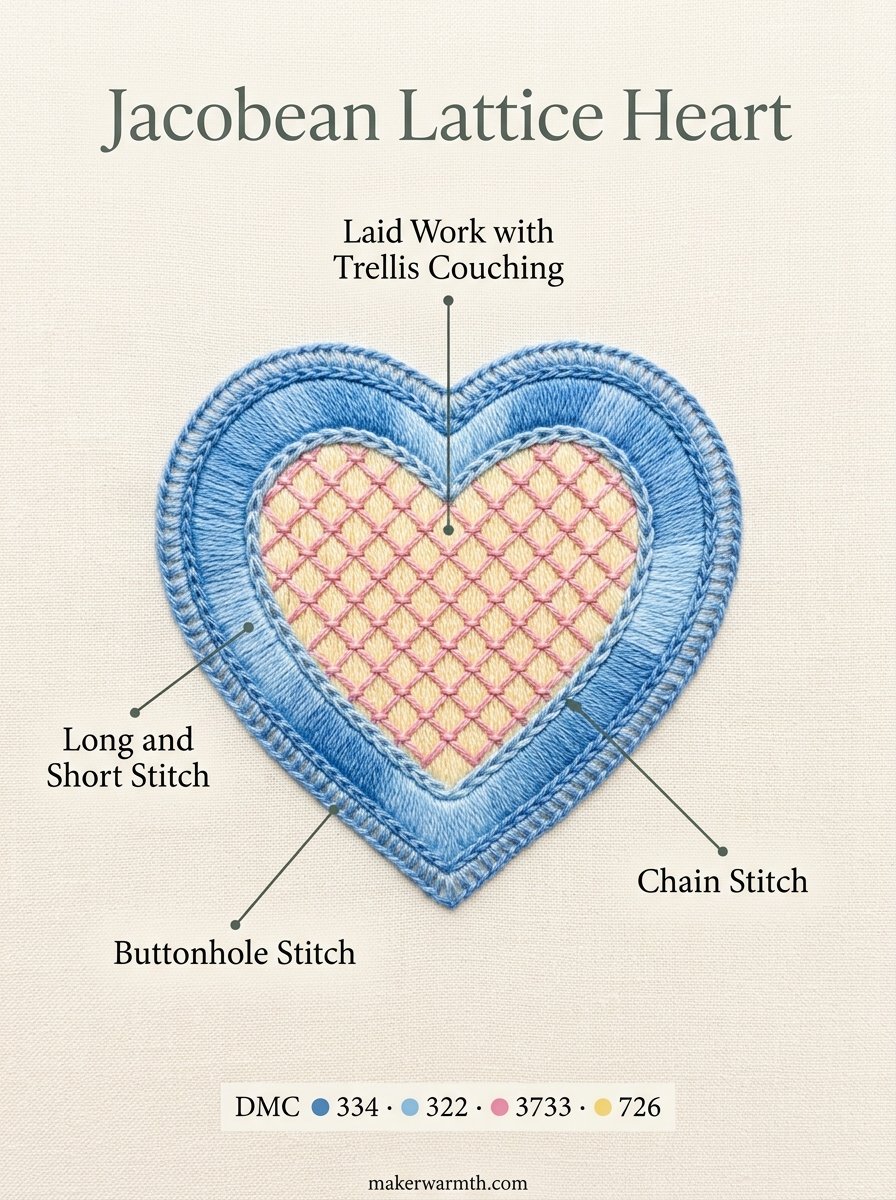
A lattice-filled heart inside a shaded blue border. Lovely as a small gift or a Valentine’s piece.
Stitches: laid work with trellis couching, long and short stitch, buttonhole stitch, chain stitch.
DMC colors: 334, 322, 3733, 726.
Printable outline: page 10 of the free PDF.
- Fill the inner heart with laid threads in 726 and a diagonal couched grid in 3733.
- Shade the wide border with long and short stitch, 322 on the inside blending into 334.
- Edge the outside of the border with buttonhole stitch.
- Outline the inner heart in chain stitch.
10. Jacobean Butterfly

Violet wings with turquoise scalloped edges and gold dots.
Stitches: long and short stitch, buttonhole stitch, French knots, stem stitch.
DMC colors: 550, 553, 3810, 725.
Printable outline: page 11 of the free PDF.
- Shade each wing with long and short stitch, 550 near the body fading into 553.
- Edge the wings with buttonhole stitch in 3810.
- Add French knots in 725 on the wings.
- Stitch the body and curled antennae in stem stitch.
11. Jacobean Thistle
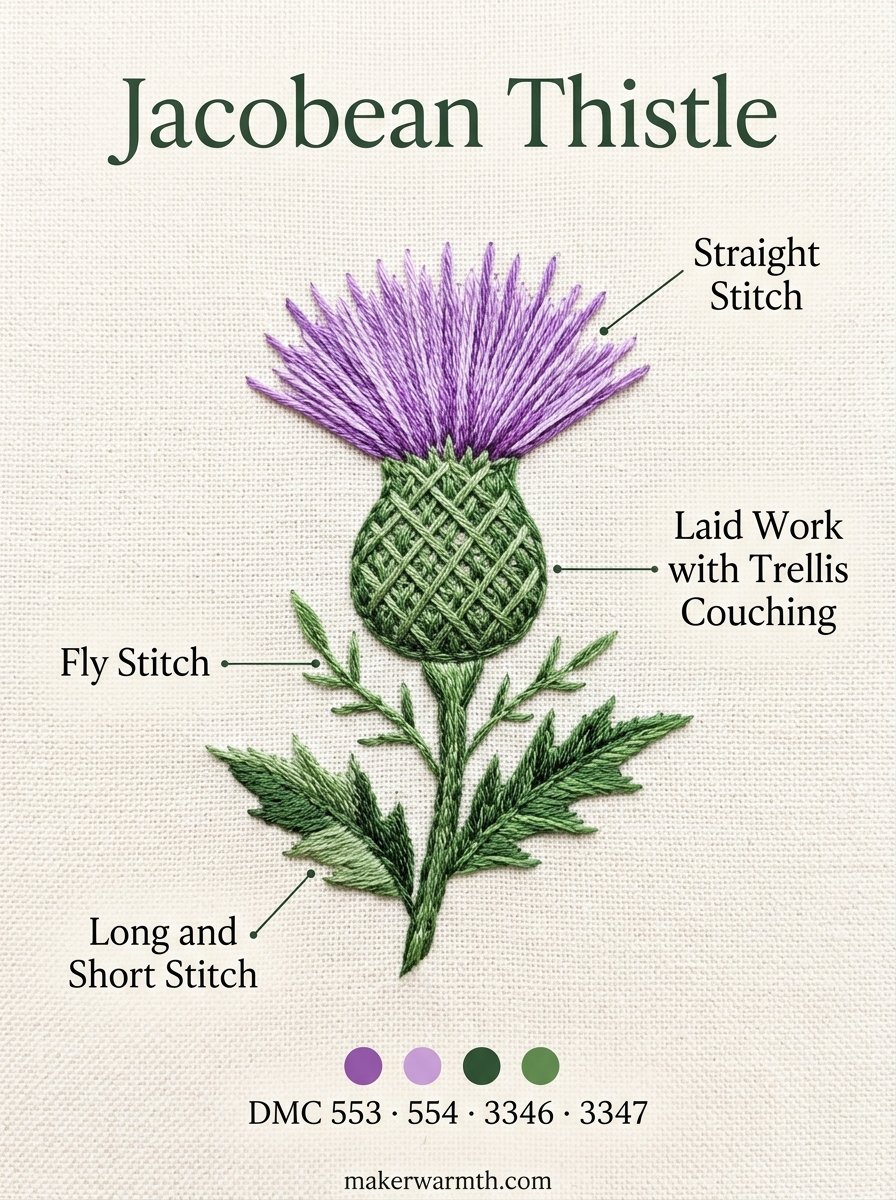
A spiky lilac flower head on a lattice base with sharp green leaves.
Stitches: straight stitch, laid work with trellis couching, fly stitch, long and short stitch.
DMC colors: 553, 554, 3346, 3347.
Printable outline: page 12 of the free PDF.
- Fan straight stitches out from the base for the flower head, mixing 553 and 554.
- Fill the round base with laid threads and a couched grid in 3346 and 3347.
- Shade the leaves with long and short stitch.
- Add fly stitches along the leaf edges for the spikes.
12. Jacobean Acanthus Leaf
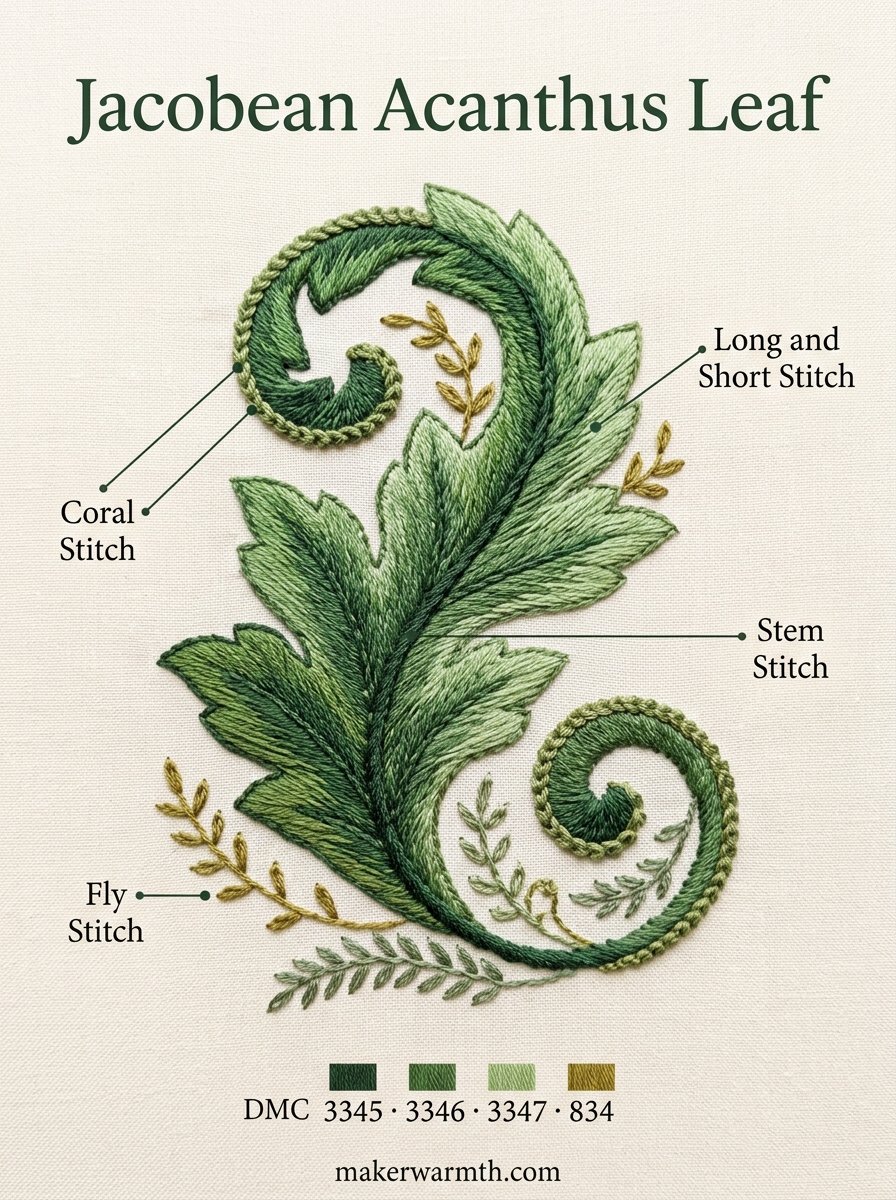
The signature Jacobean leaf, rolling into a spiral. Smooth shading is what makes it work.
Stitches: long and short stitch, stem stitch, coral stitch, fly stitch.
DMC colors: 3345, 3346, 3347, 834.
Printable outline: page 13 of the free PDF.
- Shade the leaf with long and short stitch in three greens, darkest on the inside of the curl.
- Stitch the central vein in stem stitch.
- Work the knotted line along the edge in coral stitch.
- Add small fly stitch sprigs in 834 at the base.
13. Jacobean Tree of Life
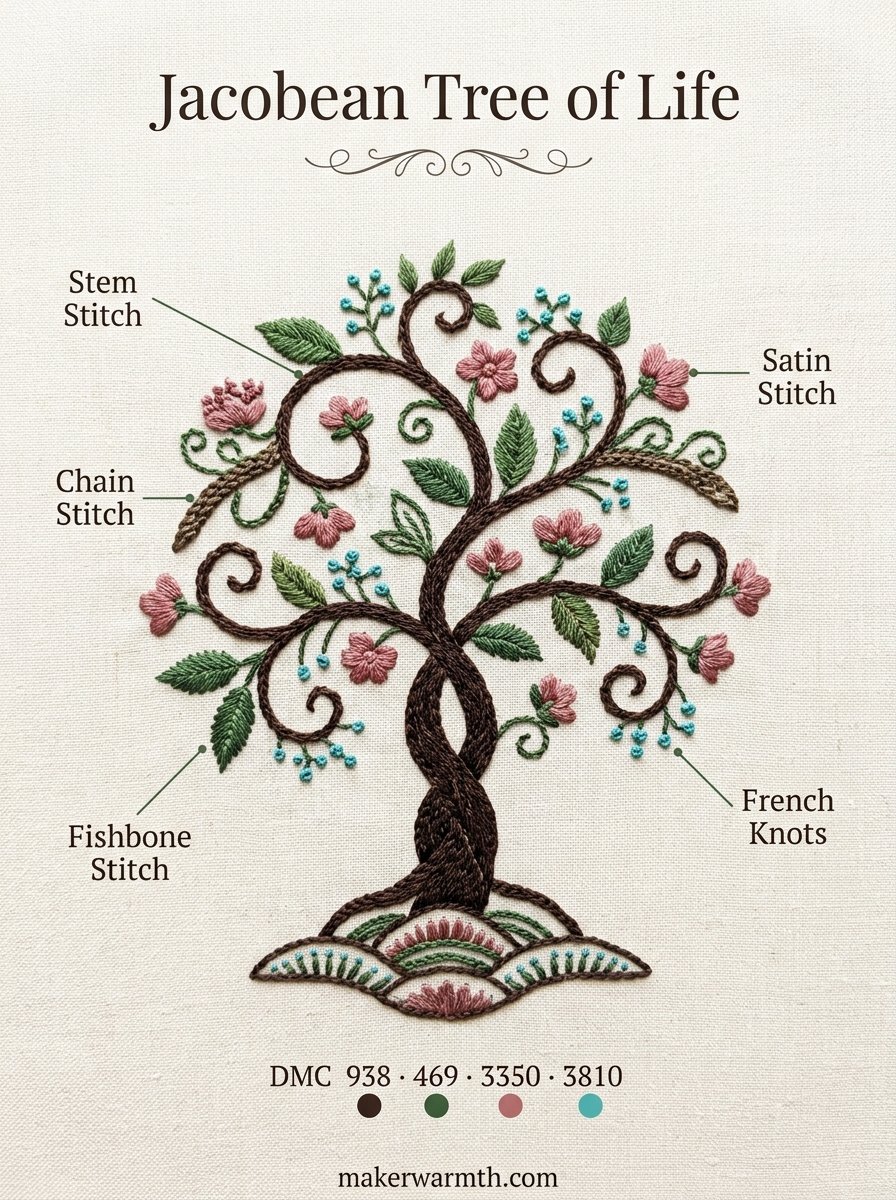
A twisting trunk with curling branches. The tree of life is one of the most traditional Jacobean compositions.
Stitches: stem stitch, chain stitch, fishbone stitch, satin stitch, French knots.
DMC colors: 938, 469, 3350, 3810.
Printable outline: page 14 of the free PDF.
- Fill the trunk with close rows of stem stitch in 938, following its twist.
- Stitch the branches in chain stitch.
- Work the leaves in fishbone stitch with 469 and the flowers in satin stitch with 3350.
- Scatter French knots in 3810 between the branches.
14. Jacobean Pomegranate
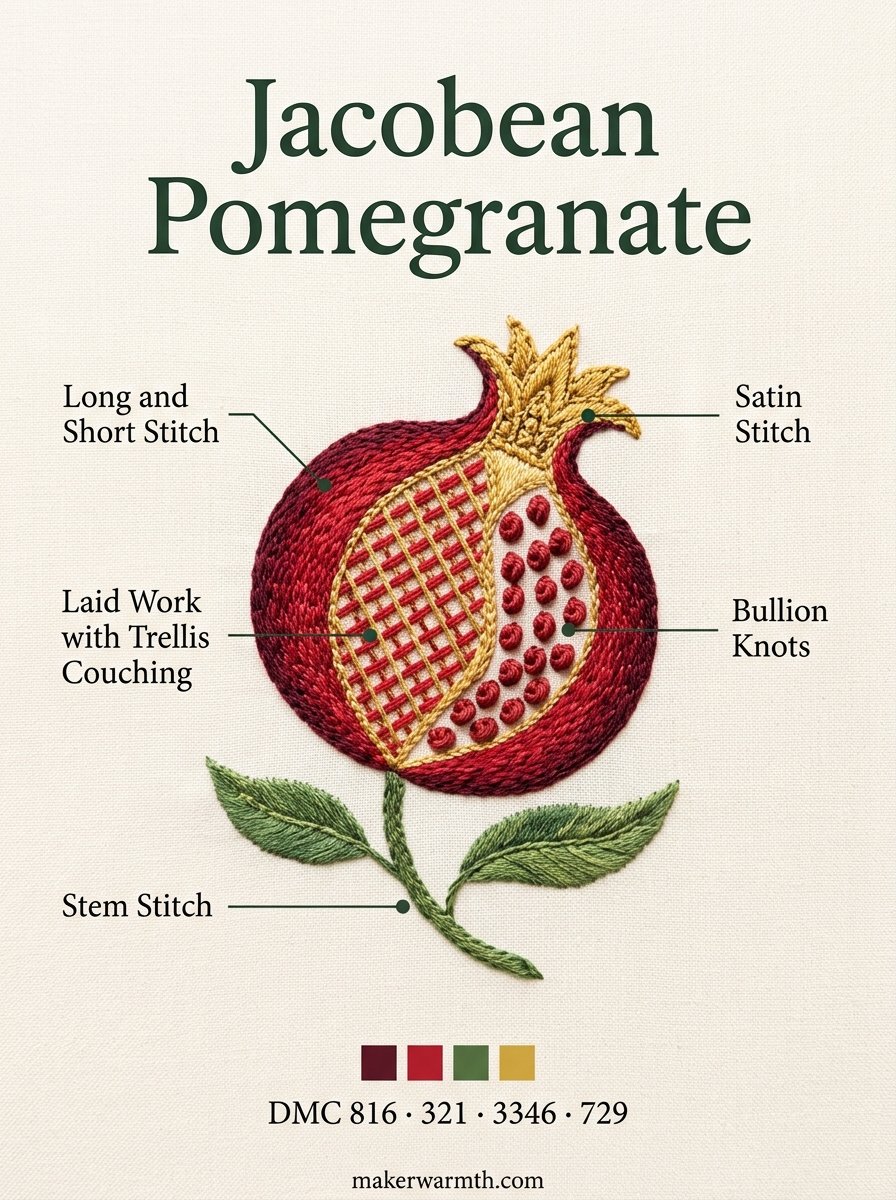
A deep red fruit split open to show its seeds, with a gold crown.
Stitches: long and short stitch, laid work with trellis couching, satin stitch, bullion knots, stem stitch.
DMC colors: 816, 321, 3346, 729.
Printable outline: page 15 of the free PDF.
- Shade the outer fruit with long and short stitch, 816 at the edges and 321 toward the center.
- Fill the open section with a couched lattice in 321 and add bullion knot seeds.
- Work the crown in satin stitch with 729.
- Stitch the stem in stem stitch and fill the leaves with 3346.
15. Jacobean Fox
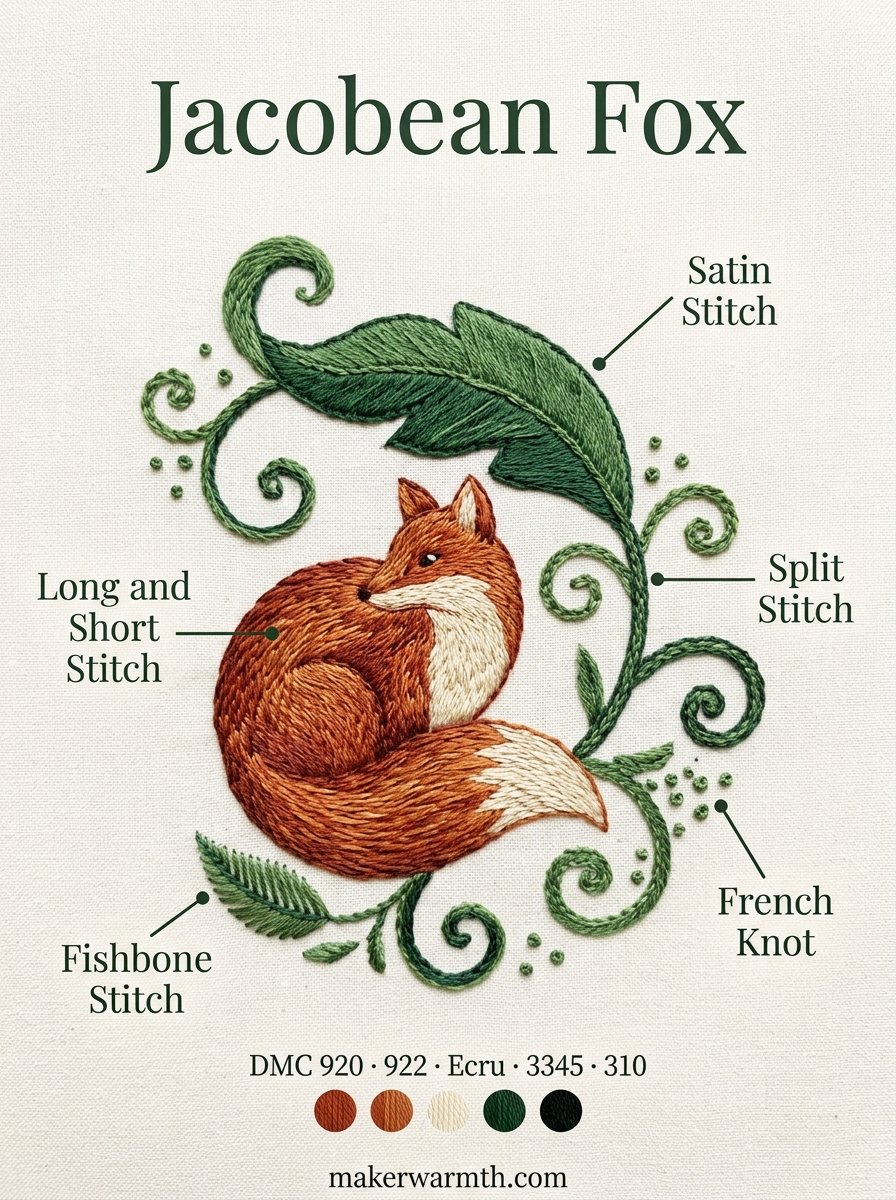
The most detailed pattern here: a curled fox shaded like thread painting, tucked under curling leaves.
Stitches: long and short stitch, satin stitch, split stitch, fishbone stitch, French knot.
DMC colors: 920, 922, Ecru, 3345, 310.
Printable outline: page 16 of the free PDF.
- Outline the fox in split stitch so the shading has a neat edge.
- Shade the fur with long and short stitch in 920 and 922, following the direction of the fur, and fill the chest with Ecru.
- Fill the ears in satin stitch and add a French knot eye in 310.
- Work the leaves in fishbone stitch with 3345.
Jacobean Embroidery on Clothes
Jacobean motifs look beautiful on a linen shirt, a denim jacket back or the front of a cardigan. Choose a firm woven fabric, put stabilizer on the inside and keep long floats short: laid work and trellis couching can snag on everyday clothes, so on garments use smaller lattices or swap them for seed stitch. Single motifs like the strawberry, the tulip or the acorn fit a pocket or a collar.
More floral designs sized for clothes:
20 Flower Embroidery Designs to Stitch on Your Clothes
Border Embroidery Designs: 15 Easy Hand Embroidery Borders for Clothes
Denim Jacket Embroidery Ideas: 12 Free Printable Patterns
Jacobean Embroidery FAQ
What is the difference between Jacobean and crewel embroidery?
Crewel embroidery means embroidery worked in wool. Jacobean is a style of design, with stylized plants, fruit and animals. Jacobean designs are traditionally worked as crewel, which is why the two names are often used together.
Can I do Jacobean embroidery with cotton floss?
Yes. All the patterns here are stitched in six-strand cotton floss. Wool gives a softer, raised texture, and cotton gives a smoother look with more sheen.
Is Jacobean embroidery good for beginners?
Start with patterns that use few stitches, like the trellis leaf, the strawberry or the tulip. Leave long and short shading on large shapes, such as the fox or the acanthus leaf, for when you feel comfortable.
What fabric is best for Jacobean embroidery?
Traditionally linen twill. Any firm, medium-weight linen or linen-cotton works well. Keep it tight in a hoop or frame so the laid threads stay flat.
Can I do Jacobean embroidery on clothes?
Yes, on firm woven fabrics like linen, denim or cotton twill. Use stabilizer, choose smaller motifs and avoid very long laid threads on areas that rub, such as cuffs.